Powering India’s Secondary Steel Transition: Why Renewable Electricity Makes Business Sense
India’s journey towards green steel often centres on breakthrough technologies like green hydrogen. But what if one of the biggest decarbonisation opportunities is already commercially viable today?
India’s secondary steel sector, which contributes nearly 40% of the country’s crude steel production, faces a dual challenge of managing rising electricity costs while reducing emissions. Electricity alone accounts for up to 40% of operating costs for many secondary steel MSMEs, making affordable clean power a business imperative, not just a sustainability goal.
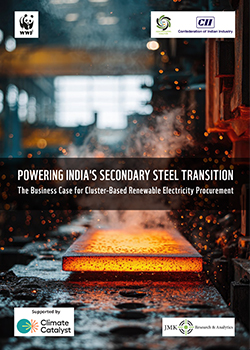
Powering India’s Secondary Steel Transition: The Business Case for Cluster-Based Renewable Electricity Procurement, jointly developed by IGSC – a joint initiative of WWF-India and CII – and supported by Climate Catalyst. It explores how renewable electricity can become one of the fastest and most cost-effective pathways to decarbonise India’s secondary steel industry.
Where does the biggest opportunity lie?
The report reveals that renewable electricity is no longer simply an environmental choice. Across several states, renewable power is already available at ₹4.5–6 per unit, compared to conventional grid tariffs of ₹7–8 per unit, creating immediate cost-saving opportunities for steel MSMEs. Yet renewable energy adoption within the secondary steel sector remains only around 11%, well below the national renewable share in electricity generation.
Rather than focusing only on technology, the report investigates why this commercially attractive opportunity remains underutilised. It develops a Renewable Energy Attractiveness Index to evaluate India’s major secondary steel clusters, identifying Raipur, Belgaum, Shimoga, Rajkot and Bhavnagar as the country’s most promising locations for renewable electricity deployment.
From analysis to actionable business models
The report undertakes detailed assessments of Raipur and Rajkot, combining field visits with long-term financial modelling of three renewable procurement pathways: Full Capex, Group Captive and Third-party Open Access.
Among these, Group Captive consistently emerges as the most practical and scalable model for MSMEs. In Raipur, for example, a representative 10 MW Group Captive solar project can generate annual savings of around ₹2.4 crore, recover investments within one to two years and avoid approximately 12,500 tonnes of CO₂ emissions annually.
Building an enabling ecosystem
The study also highlights that the biggest barriers are no longer technological. Instead, regulatory implementation, financing constraints and fragmented renewable procurement continue to slow adoption. It therefore proposes targeted policy interventions including time-bound open access concessions, portfolio-level credit guarantees and standardised Group Captive regulations to unlock renewable electricity at scale.
Download the full report to explore the detailed cluster assessments, financial models and policy recommendations shaping the next phase of India’s green steel transition.