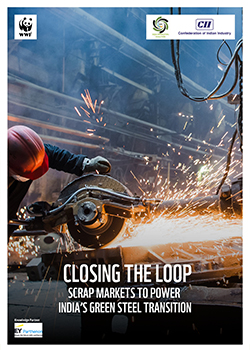
India’s steel sector faces a dual challenge: scale production to support economic growth while rapidly reducing emissions intensity. One of the most immediate solutions already exists within the system — ferrous scrap.
India currently consumes about 41 MMT of scrap annually yet scrap accounts for only 23% of crude steel production, compared to 32% globally and 60–70% in advanced economies. Increasing scrap utilisation represents one of the fastest and most cost-effective pathways to reduce emissions in Indian steelmaking.
How Scrap Delivers Immediate Emissions Reduction
Scrap directly substitutes primary ironmaking, cutting emissions without waiting for new technologies.
- Raising scrap share in BF–BOF steelmaking from 15% to 25% reduces emissions intensity by ~11%.
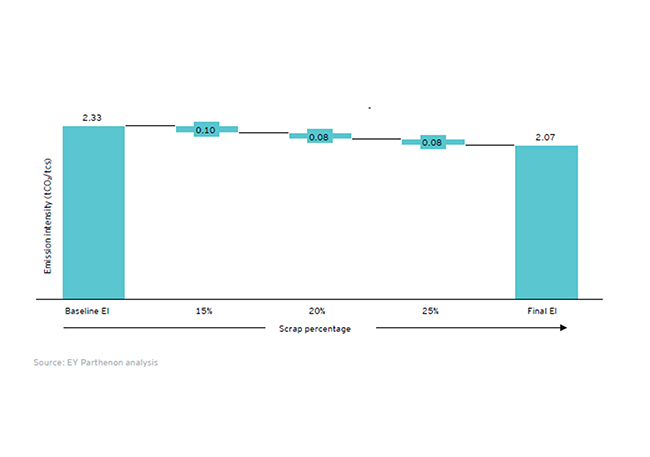
- Increasing scrap share in DRI–EAF from 20% to 60% cuts emissions intensity by ~43%
Figure 1: Reduction in emission intensity in BF-BOF steelmaking through scrap addition
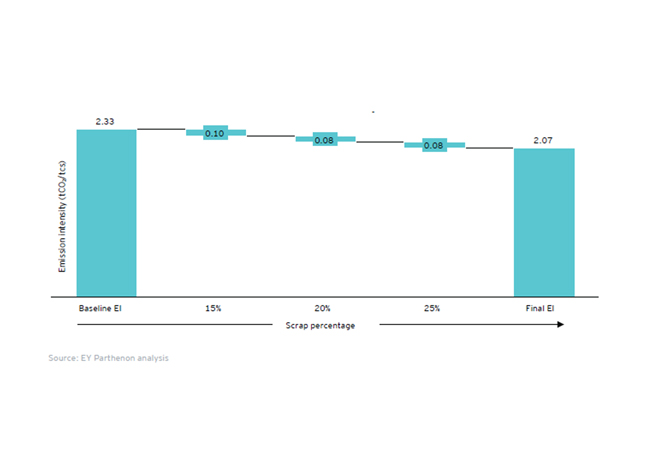
Figure 2: Reduction in emission intensity in NG DRI-EAF steelmaking through scrap addition
These gains can be achieved through operational measures such as scrap preheating, improved charge mix, and furnace optimisation. Scrap is therefore the most deployable decarbonisation lever available today.
A Growing Supply Gap
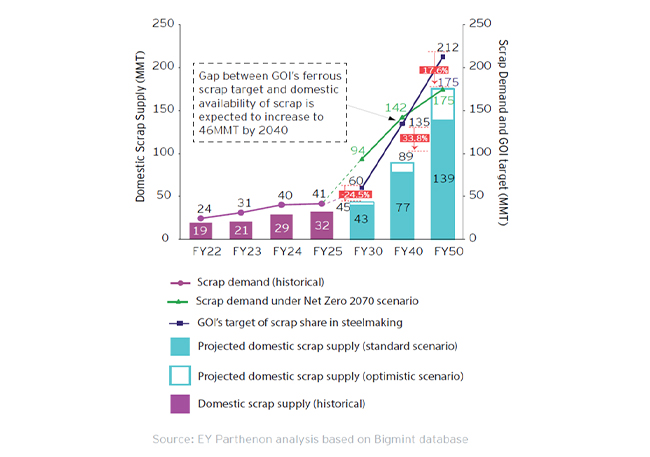
Demand for scrap is projected to exceed 200 MMT by 2050, while domestic availability could fall short by 40–50 MMT, even under optimistic scrap generation scenarios of 8% CAGR.
Figure 3: India’s widening supply-demand gap of ferrous scrap
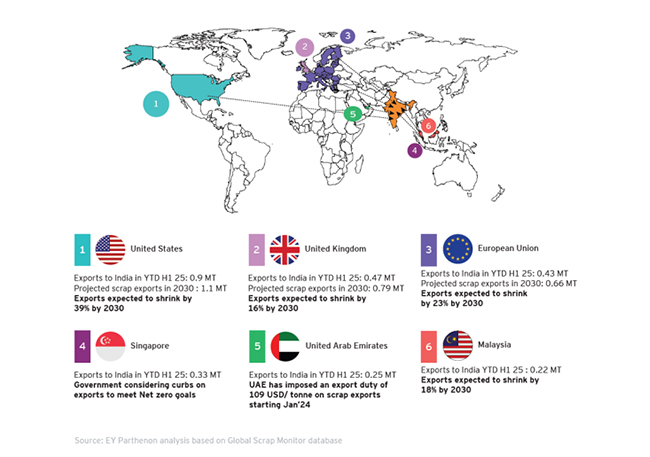
At the same time, global scrap markets are tightening. Over 60 countries have introduced export restrictions, and global trade volumes are projected to decline by 15% by 2030. Major exporting economies are retaining scrap to support their own decarbonisation goals.
Figure 4: Scrap import volume and expected shrink by 2030
From Opportunity to Strategic Imperative
1. Recognise scrap as a strategic resource.
Ferrous scrap should be formally designated as a strategic secondary raw material within national steel and industrial planning frameworks.
2. Close the execution gap.
Despite policy support, only ~3% of eligible vehicles have been scrapped, even though nearly 12 million qualify. Stronger implementation across vehicle scrappages, ship recycling, and construction demolition streams is essential to expand domestic supply.
3. Improve quality and traceability.
Inconsistent grading and contamination limit higher scrap charge ratios. National quality standards, certification protocols, and digital traceability systems are needed to enable greater utilisation.
4. Strengthen value chain integration.
Steelmakers remain exposed to supply uncertainty and price volatility. Strategic investment in collection, dismantling, and processing infrastructure can enhance supply security and improve cost stability.
5. Develop regional scrap processing hubs.
Scrap consumption is concentrated in clusters such as Punjab, Jalna, and Chennai, yet processing infrastructure remains fragmented. Establishing integrated regional hubs with shredding, sorting, grading, and testing facilities can improve efficiency, reduce logistics costs, and strengthen local circularity.
Energy Security and Competitiveness
Every tonne of scrap used in place of primary inputs avoids approximately 1.4 tonnes of iron ore, 740 kg of metallurgical coal, and 120 kg of limestone, reducing dependence on fossil-based raw materials.
Higher scrap utilisation enhances cost stability, improves energy resilience, and strengthens competitiveness under emerging carbon border measures and emissions-linked trade regimes.
Dual policy focus on effective ferrous scrap utilization in the near term, alongside scaling green hydrogen–based DRI steelmaking as a long-term lever
Scrap represents the fastest transition lever available today. However, long-term decarbonisation will also require scaling green hydrogen–based DRI steelmaking alongside improved scrap circularity.
India’s green steel transition will depend not only on technological innovation, but also on how effectively it secures scrap supply, strengthens recycling ecosystems, and integrates resource planning into national industrial strategy.
Ferrous scrap is no longer waste. It is a strategic input that can anchor a resilient and competitive low-carbon steel future.